Showing posts with label rock. Show all posts

Saturday, November 12, 2016

120. The Moody Blues - A Question of Balance


Flickr Download DeviantArt


This work is based on the painting by Phil Travers and I expanded it to the right to make
a great screensaver. I don't want to put a description on the original painting or my own
 deviation, but it really makes for a great album cover,  which is a bit detached from the 
album title.  After 120 deviations  within a year  and a half of deviating,  I've found that
the symbolism expands when the title is detached from the art.

And then the viewer  enters somewhere in between  and goes down to the music within.


My deviation is based on the front album cover.


And that's not all. The symbolism expands to the art below it.


The gatefold is different. It opens from top to bottom instead of left to right.


Phil Travers originally  included a small  painting of a man named  Blashford Snell  within the collage of A Question of Balance (AqoB). Snell
was a well-known  British  explorer  and  children's advocate,  and the  painting on  AQoB was  inspired by a photograph, which appeared in
National Geographic.  The original album  image was of Snell  wearing a pith helmet,  holding a pistol and pointing it at an elephant. After
the album was released, Snell sued Decca Records and the Moodies over the image,  which he said was "a source of constant embarrassment
over being on the cover." rainblow.glo on Travelling Eternity Road at yuku.com


Painting by Phil Travers, photos by David Rohl,  photo montage by Mike Goss & David Rohl.  Album produced by Tony Clarke. Threshold 1970.


The Moody Blues' first real attempt at a harder  rock sound still has  some psychedelic elements,  but they're  achieved with an overall leaner
studio sound.  The group was trying to take  stock of itself at this time,  and came up with some  surprisingly strong,  lean numbers (Michael
Pinder's Mellotron is surprisingly restrained until the final number, "The Balance"),  which also embraced politics for the first time ("Question"
seemed to display the dislocation that a lot of younger listeners were feeling during Vietnam).

The surprisingly jagged opening track,  "Question,"  recorded several months earlier,  became a popular concert  number as well as a number
one single.  Graeme Edge's  "Don't You Feel Small"  and Justin Hayward's  "It's Up to You"  both had a great beat,  but the real highlight here is
John Lodge's "Tortoise and the Hare,"  a fast-paced  number that  the band  used to rip  through in  concert with  some searing guitar solos by
Hayward.

Ray Thomas'  "And the Tide Rushes In"  (written in the wake of a fight with his wife)  is one of the prettiest  psychedelic songs ever written, a
sweetly languid  piece with some gorgeous  shimmering  instrumental effects.  The 1997 remastered edition  brings out the guitar sound with
amazing force and clarity, and the notes tell a lot about the turmoil the band was starting to feel after three years of whirlwind success.
The only loss is the absence of the lyrics included in earlier editions. Bruce Eder for AllMusic


(A) Question - How Is It (We Are Here) - And the Tide Rushes In - Don't You Feel Small - Tortoise and the Hare

(2) It's Up to You - Minstrel's Song - Dawning is the Day - Melancholy Man - The Balance


"Melancholy Man" live from Borys W. on YouTube.


Monday, October 31, 2016

119. Metallica - Master of Puppets


Flickr Download DeviantArt


Right from the cover art,  Master of Puppets  promised an even  greater degree of  political
awareness.  Dog tags hang from  military-style  grave markers,  each headstone attached to
strings leading to the  shadowy hands of an unseen puppet master. The graves are nameless,
arranged in neat rows — anonymous  soldiers paid  token respect for  their  sacrifice though
nobody  can  be bothered  to clear  the  overgrowth  choking  their graves.  The setting sun 
reinforces the scene’s sense of death and abandonment.
Metallica's Master of Puppets, Loudwire


Having read that,  I lost appetite for writing  my own short story about the work above, but
it's Halloween  and I think I had  to say  something  about remembering  the dead.  In other
words, let us think and ask,  "who is the puppet now?"

Is it the living, or the dead?


No. 59, Entertainment Weekly, 100 Greatest Albums Ever; No. 105, The Virgin All-Time Album Top 1000;
No. 167, Rolling Stone, The 500 Greatest Albums of All Time; No. 268, Billboard, The 300 Best-Selling Albums of All Time. 


Cover concept by Peter Mensch & Metallica;  illustration by Don Brautigam; photography by Ross Halfin, Rich Likong & Rob Ellsi.
Album produced by Metallica and Flemming Rasmussen.


Master of Puppets is one of the best metal albums of the '80s. It's a rare achievement: a crossover hit that compromises nothing.
Much like their previous album  Ride the Lightning  but with even  stronger material,  Master of Puppets  blends  metal's natural
aggression with subtle  shifts in dynamics  and expanded  compositional  textures to expand and refine its sonic reach.  "Battery"
leads things  off with the  unforgiving pummel  of their  earliest thrash,  but the  eight-and-a-half  minute title  track delivers a
complex sermon  on feelings of human  powerlessness and  overreaching  authority backed  by an arrangement that is cinematic
in scope, displaying the group's moodiest overtures alongside its most direct attack.

The playing is airtight  throughout — the instrumental  "Orion" a showcase for the group's  syncopated intuition — with the songs
thematically united as well,  offering up a world on the brink of chaos and insanity. "Welcome Home (Sanitarium),"  "Disposable
Heroes" and "Leper Messiah" are textbook cases of adolescent rage and frustration towards an uncaring system. itunes review


The cover painting was done by Don Brautigam,  an illustrator out of New York’s prestigious  School of Visual Arts.  Brautigam had been working as a
commercial artist for 15 years prior to this project, designing both album and book covers along with illustrations for magazines and advertisements.
Prior to Master of Puppets, his most recognizable work may have been the cover for Stephen King’s 1980 novel The Stand, which won a “cover of the
year” award from a trade group named Marketing Bestsellers.

Brautigam used acrylic paints on illustration board,  combining traditional brushes with airbrush, the latter giving  Master of Puppets its dreamy, soft
focus feel.  Some sources  claim that the  artist  worked from a drawing  provided by  James Hetfield,  but what no one disputes is the quality of the
finished artwork.  In his book  Fade to Black,  Martin Popoff  says that painting “is gorgeously possessive of both depth and striking color sense, given
the contrast between the pure white of the crosses and the multiple rich shades of brown both above and below.”

The Art of Metal calls the image “striking.” Metallica's Master of Puppets, Loudwire


(A) Battery - Master of Puppets - The Thing That Should Not Be - Welcome Home (Sanitarium)

(B) Disposable Heroes - Leper Messiah - Orion - Damage, Inc.


"Master of Puppets" live from MetallicaVEVO on YouTube.


metallica.com

Back to Gallery 4


Tuesday, October 25, 2016

118. Rod Stewart - Every Picture Tells a Story


Flickr Download DeviantArt


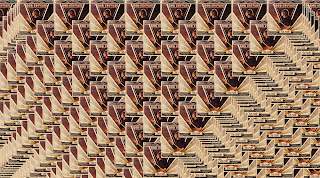
I haven't counted the number of copies of the album front sleeve design I used in filling the space above because I was preoccupied with creating the patterns of
insertions left and right. I did start at bottom centre moving upwards and sideways. The decisions I made were spontaneous with the creative effort and
once the patterns were established it was only a matter of measurements and, of course, some mathematics.

The fan pattern  (or the rays,  as you may love to call it)  on the album art did give me the seminal idea and the direction from which to progress.
The horizontal bars  (and more rays)  at the top and the  bottom of  the design  also gave me a sense of  balance and  structure. That may
sound like much analyses, but really, I was amazed at my own work.

Every picture tells a story. The album title aptly describes the work itself.  


No. 172, Rolling Stone, The 500 Greatest Albums of All Time;
No. 236, The Virgin All-Time Album Top 1000.

Art direction by Des Strobel, design & illustration by John Craig, photo by Lisa Margolis. 
Album produced by Rod Stewart. Mercury 1971.


Radio overplay of “Maggie May” at the time of this album’s release proved that familiarity can breed contempt (at least when it comes to music). As a result, I
never got “into” early  Rod Stewart  solo material  at the time it was released.  But with the  passage of time, exposure and  perhaps a bit of nostalgia, I
started listening to his early albums. (The same thing happened with Elton John but that’s another story and a different article).

Rod had already proven his mettle as a blues wailer on Truth (a Jeff Beck Group album),  and had a couple  interesting albums on Vertigo (Records)
while also working with the Faces (the English rock band that was formed by members of The Small Faces after Steve Marriott left the group
to form Humble Pie). This, his third album, really carried the ball forward for Stewart as a brand name talent. Despite its commercial
success, it is a very good album, perhaps even better with the passage of time. I now regard it as a classic. Why?

It’s a combination of some  good songs and a few great ones;  some impressive stringed instrument playing that adds layers of
texture and interesting details,  but at bottom, it just rocks– Rod is in prime form,  and the power of the songs, top-tier
playing and  a driving  beat gets your  head  bobbing.  One of  the things  I like  about this era  of rock  is that the
recordings typically  are not over-produced.  There is a lot going on here,  but it isn’t  “slick” sounding. The
fact that some of these  songs are so familiar is no  longer a negative to me;  I guess that’s where the
nostalgia  part kicks in.  It’s a hell  of an album,  and if you  haven’t  listened  to it in years, be 
prepared to enjoy yourself. Immensely. The Vinyl Press


(A) Every Picture Tells a Story - Seems Like a Long Time - That's Alright - Amazing Grace - Tomorrow is a Long Time

(B) Henry - Maggie May - Mandolin Wind - I Know (I'm Losing You) - Reason to Believe


"Reason to Believe" live from diegol3d on YouTube.


  www.rodstewart.com


Back to Gallery 4


Monday, October 24, 2016

122. Jimi Hendrix - Band of Gypsys


Flickr Download DeviantArt


The original album cover art shows Jimi Hendrix  performing at Fillmore East under multi-colored lights.  It is reproduced here three times in different sizes.
Band of Gypsys, which were Hendrix without The Jimi Hendrix Experience,  his original group, but with Billy Cox on bass and Buddy Miles on drums, recorded
the album live at Fillmore East on January 1, 1970. Band of Gypsys was Hendrix's last before he died of accidental drug overdose on September 18, 1970. The
image of Hendrix at left is from a poster I obtained from another source (which I couldn't locate anymore - many thanks to the artist!).  It reminds me of the
tongues of fire that consumed his guitar on stage on the cover of Fire: The Jimi Hendrix Collection, his posthumous album. It is also like the spirit of Hendrix
hovering above his audience as he played on stage.

Jimi Hendrix is ranked as the greatest rock guitarist of all time.


This is the original album cover art design.


No. 529, The Virgin All-Time Album Top 1000.


Photo by Jan Blom, cover design by Victor Khan.
Album produced by Jimi Hendrix (listed as Heaven Research). Capitol 1970. 


Track (Records) used album cover art which proved controversial. It depicted unflattering puppets or dolls that resembled Hendrix,
Brian Jones,  Bob Dylan,  and John Peel  huddled next to a drab,  corrugated  backdrop.  The significance  of posing the three with
Hendrix was not evident as they had no known association with the Band of Gypsys nor the group's material. wikipedia


 The album mixes funk and rhythm and blues elements with hard rock and jamming,  an approach which later became the basis
of funk rock.  "Machine Gun"  is generally  regarded as the album's  highlight and  one of Hendrix's greatest  achievements. The
influence of Band of Gypsys is heard in the funk rock  developments of the 1970s and has been cited as an inspiration by various
later rock musicians.

Writer Rickey Vincent  describes  Band of Gypsys as  "a never-heard-before  amalgam of punishing guitar  riffs over crisp rhythm
and blues grooves. . .  The funk-rock sound would change the face of black music,  setting a template for the spectacular glam-
funk of the 1970s".  Music writer  Corey Washington adds,  "the Band of Gypsys  pioneered a unique  style of funk that placed the
guitar in the mix right along with the bass. . . [they] took funk to the next level because of their rock background." wikipedia


(A) Who Knows - Machine Gun

(B) Changes - Power of Soul - Message to Love - We Gotta Live Together


117. John Lennon - Mind Games/Imagine


Flickr Download DeviantArt


This work combines the artwork of two album covers namely, Mind Games and Imagine, both by John Lennon. I'm not a great fan of John Lennon (alone), but I can dare say that Imagine is the
better album musically, but Mind Games has a better artwork.  Combining the two wasn't much of a hassle; there are the two faces to combine and the clouds naturally unite them. The album
titles say it already - there are as much mind games to imagine as there are imaginable things to play mind games with.

"You may say I'm a dreamer, but I'm not the only one."


John Lennon designed the  artwork for Mind Games  himself.  The front cover pictured him  alone in a wilderness,  overshadowed by a mountain-
sized rendering of Yoko Ono. The meaning was obvious: he was adrift without Ono, although her influence was still the dominant force in his life.

The image also featured two suns were in the sky,  symbolising the spirits of the pair.  The same image was repeated on the rear cover,  but with
Lennon's figure slightly larger and with a rainbow in place of the suns. The Beatles Bible

The front cover (on Imagine) was a Polaroid taken by Andy Warhol. The back cover photograph was taken by Yoko Ono. A quote from Ono's book
Grapefruit  (which the Lennons were in the process of promoting the re-release of in the UK)  was also included on the back cover: "Imagine the
clouds dripping. Dig a hole in your garden to put them in." wikipedia


Mind Games:

Cover art by John Lennon, copyright by Yoko Ono. Album produced by John Lennon. Apple 1973.

Imagine:

No. 80, Rolling Stone, The 500 Greatest Albums of All Time; No. 128, The Virgin All-Time Album Top 1000.

Photo by Andy Warhol, copyright by Yoko Ono. Album produced by John Lennon, Yoko Ono & Phil Spector. Apple 1971.


Mind Games captured this state of flux in Lennon's life.  The songs ranged from aimless fillers ("Intuition", "Bring On The Lucie", "Only People")  to up-tempo rockers ("Tight A$", "Meat City").
The lack of a unifying theme hadn't prevented Lennon from producing great work in the past, as demonstrated on Imagine, but Mind Games lacked enough great moments to mask the sense
that this once-great composer and performer was treading water.

The title track,  along with "Bring On The Lucie (Freeda Peeple)"  and "Only People",  showed that Lennon hadn't lost his belief in peace or the power of people to change the world,  even if
the results lacked the conviction and drive of his earlier solo work.  The three-second silent track "Nutopian International Anthem", meanwhile, showed that even if he hadn't lost his skill at
subverting expectations, there was little radical spirit to back it up. The Beatles Bible


The track "Imagine" became Lennon's signature song and was written as a plea for world peace. Years later he gave credit to his wife Yoko Ono who co-wrote the song. "Jealous Guy" has also
had enduring popularity; it was originally composed as "Child of Nature" during the songwriting sessions in India in 1968 that led to The Beatles' double album The Beatles. "Oh My Love" and
the song "How?" were influenced by his  experience with primal therapy:  "How?" contains the questions he was facing  while going through the changes  produced in him  during the ongoing
process of primal therapy, while "Oh My Love" was written to communicate the joy and growth Lennon was experiencing as a result of the therapy.

Lennon would later  express his displeasure  with the more commercial  sound of the album,  even going  so far as to say that  the title  track was "an anti-religious,  anti-nationalistic, anti-
conventional, anti-capitalistic song, but because it's sugar-coated, it's accepted." In a November 1971 interview for Melody Maker, McCartney spoke positively of Imagine, considering it to be
less political  than Lennon's previous solo albums.  In a subsequent  edition of the same publication,  Lennon rebuked his former bandmate,  saying,  "So you think 'Imagine' ain't political? It's
'Working Class Hero' with sugar on it for conservatives like yourself!!" Imagine was voted as Radio Luxembourg's "Album of the Year" on 24 December 1971. wikipedia


Mind Games:

(A) Mind Games - Tight A$ - Aisumasen (I'm Sorry) - One Day (at a Time) - Bring It on the Lucie (Freda Peeple) - Nutopian International Anthem

(B) Intuition - Out the Blue - Only People - I Know (I Know) - You Are Here - Meat City

Imagine:

(A) Imagine - Crippled Inside - Jealous Guy - It's So Hard - I Don't Want to be a Soldier

(B) Gimme Some Truth - Oh My Love - How Do You Sleep - How? - Oh, Yoko


"Imagine" from David Holguin on YouTube.


Monday, October 10, 2016

116. ABBA - The Album


Flickr Download DeviantArt


On this work the  album's front and back  covers are placed  side by side with  each other and part of the white  background  has been  converted to black.


ABBA The Album  was released in Scandinavia  on 12 December 1977  through Polar Music,  but due to the massive  pre-orders the  UK pressing plants were
not able to press sufficient copies  before Christmas 1977  and so it was not released in the UK until January 1978.  The album was released in conjunction
with ABBA: The Movie, with several of the songs featured in the film.

Polar's official cover featured an entirely white background,  and is the basis for current CD versions.  However,  Epic Records'  original UK release of the LP
featured a blue background on the front cover, fading to white at the bottom. It also featured a gatefold sleeve. The back cover was altered, incorporating
a similar photo of ABBA to that used  elsewhere in the world for the inner sleeve,  and referencing tracks included in  ABBA: The Movie.  The inner gatefold
was designed to look like an air mail envelope,  similar to the style later used for  Gracias Por La Música  and even had a photo of ABBA incorporated into a
stamp in the corner. wikipedia


We had a vinyl copy of this album as part of our family's record collection in 1978.


Photo by Barry Levine/Mirage, album design by Rune Soderqvist, illustrations by Rune Soderqvist and Bjorn Andersson.
Album produced by Bjorn Andersson & Benny Ulvaeus. Polar, Epic (UK), Atltantic (US) 1977. 


ABBA's fifth album was a marked step forward for the group, having evolved out of Europop music into a world-class rock act over their previous
two albums,  they now proceeded  to absorb and assimilate  some of the influences  around them,  particularly the laid-back California sound of
Fleetwood Mac  (curiously,  like ABBA,  then a band with two couples at its center),  as well as some of the attributes  of progressive rock.  That
they did this without  compromising their  essential virtues  as a pop ensemble  makes this album seem even  more extraordinary,  though at the
time nobody bothered to analyze it -  The Album was simply an incredibly popular release, yielding two British number one singles in "The Name
of the Game" and "Take a Chance on Me" (which made the Top Five in America, their second-best showing after "Dancing Queen"),  and achieving
the quartet's highest-ever showing on the U.S. LP charts, reaching the Top 20 and selling a million copies in six months.
AllMusic review by William Ruhlmann

ABBA: The Album  reached number 1 in many territories.  In the UK it debuted at the top and remained  there for seven weeks,  ending up as the
third biggest selling album of the year  (behind the movie soundtrack LPs of  Saturday Night Fever and Grease).  In the US it became their highest
charting album,  where during 1978 ABBA undertook a big  promotional campaign.  Due to the Cold War,  Western music was actively discouraged
throughout Eastern  Europe at the time.  Despite this,  ABBA: The Album sold an unprecedented one million copies in Poland in 1977,  exhausting
the country's entire  allocation of foreign currency.  In Russia,  only 200,000  copies  were permitted to be pressed;  however,  demand within the
USSR indicated they could have sold 40 million copies. wikipedia


(A) Eagle - Take a Chance on Me - One Man, One Woman, The Name of the Game

(B) Move On - Hole in Your Soul - The Girl with the Golden Hair: Three Scenes from a Mini-Musical: Thank You for the Music - I Wonder (Departure) - I'm a Marionette


"Eagle" live from Superstellina2012 on YouTube.


www.abbasite.com


Previous: Fleetwood Mac - Fleetwood Mac

Next: John Lennon - Mind Games/Imagine


Back to Gallery 4