Showing posts with label screensaver. Show all posts

Saturday, December 17, 2016

126. The Mystic Moods Orchestra - Emotions


Flickr Download DeviantArt


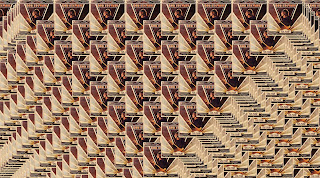
This work is purely cut and paste; nothing on the portion or whole of the album art that is part of the whole image has been hidden.
The idea is to create a symmetrical image of these parts which is just one of the many possible tweaks that can be made of the album art. 

The original album art already presents a threesome that is somewhat intriguing by itself - if one takes a quick look.
The clenched palms, of course, suggest intimacy without intention and the sprawling mane and the drawn out chin of reckless abandon.
The overlapping bodies then depict multiple intimacies and reckless abandon and my intention was to spread them out further on the sand and see what is left to be said of it. 

Or left to silent imagination.

Incidentally, there's a lot more for the imagination in the music beneath the cover.
The album begins with The Sound of Silence


The Mystic Moods Orchestra was a group known for mixing orchestral pop, environmental sounds, and pioneering recording techniques.
It was created by audiophile Brad Miller. The first Mystic Moods Orchestra album One Stormy Night, was released in 1965 through the label Philips.
Throughout the rest of the 1960s and 1970s, the group continued to release similar styled recordings and their recordings continued to be reissued throughout the 1980s and 1990s. 
wikipedia


Here is the original album cover art design.


Information wanted for photo credits. Album produced by Brad Miller. Bainbridge 1968.


Brad Miller was born in California and had developed an interest in railroading in his teens.
After a few years of hanging around rail yards and learning all the lore of steam and diesel engines,
he decided to record the sounds of some of the last steam locomotives operating on a major rail line.
Around 1958, he and his friend, Jim Connella, formed a company and started cutting records from these field recordings,
which they released through railroading magazines and model train shows.

Sound effects recording was quite the rage at the dawn of stereo, and one of these albums of train sounds was even reviewed favorably in High Fidelity magazine.
A few years later, Ernie McDaniel of San Francisco radio station KFOG decided to put one of Miller's albums, Steam Railroading Under Thundering Skies,
and an easy listening album, on separate turntables and broadcast them together.
His late-night stunt produced a barrage of listener phone calls (most of which were positive), much to his surprise.
He later related the episode to Miller, who was inspired by the idea.

While working with arranger Don Ralke, Miller recorded a series of tunes, most of them Ralke originals,
played by a string-laden orchestra, then mixed in a variety of environmental sounds he had collected.
He took several months fine-tuning the blend, then cut a deal with Philips to release it under the title of One Stormy Night,
credited to the Mystic Moods Orchestra.


With the help of producer Leo Kulka, Miller quickly developed a series of One Stormy Night clones.
The musical content shifted to mellow covers of current hits, and Warners modified the packaging of the albums to make sure
there was no mystery that these were records to serve as the preamble or accompaniment to getting it on. wikipedia


(A) The Sound of Silence - Do You Know the Way to San Jose - Eleanor Rigby - Sunny Goodge Steet - Trains and Boats and Planes

(B) Cloudy - Soldier in the Rain - Maman - Homeward Bound - Early Morning Rain - Listen to the Warm


"The Sound of Silence" from 77Fortran on YouTube


Back to Gallery 4


Saturday, November 12, 2016

120. The Moody Blues - A Question of Balance


Flickr Download DeviantArt


This work is based on the painting by Phil Travers and I expanded it to the right to make
a great screensaver. I don't want to put a description on the original painting or my own
 deviation, but it really makes for a great album cover,  which is a bit detached from the 
album title.  After 120 deviations  within a year  and a half of deviating,  I've found that
the symbolism expands when the title is detached from the art.

And then the viewer  enters somewhere in between  and goes down to the music within.


My deviation is based on the front album cover.


And that's not all. The symbolism expands to the art below it.


The gatefold is different. It opens from top to bottom instead of left to right.


Phil Travers originally  included a small  painting of a man named  Blashford Snell  within the collage of A Question of Balance (AqoB)Snell
was a well-known  British  explorer  and  children's advocate,  and the  painting on  AQoB was  inspired by a photograph, which appeared in
National Geographic.  The original album  image was of Snell  wearing a pith helmet,  holding a pistol and pointing it at an elephant. After
the album was released, Snell sued Decca Records and the Moodies over the image,  which he said was "a source of constant embarrassment
over being on the cover." rainblow.glo on Travelling Eternity Road at yuku.com


Painting by Phil Travers, photos by David Rohl,  photo montage by Mike Goss & David Rohl.  Album produced by Tony Clarke. Threshold 1970.


The Moody Blues' first real attempt at a harder  rock sound still has  some psychedelic elements,  but they're  achieved with an overall leaner
studio sound.  The group was trying to take  stock of itself at this time,  and came up with some  surprisingly strong,  lean numbers (Michael
Pinder's Mellotron is surprisingly restrained until the final number, "The Balance"),  which also embraced politics for the first time ("Question"
seemed to display the dislocation that a lot of younger listeners were feeling during Vietnam).

The surprisingly jagged opening track,  "Question,"  recorded several months earlier,  became a popular concert  number as well as a number
one single.  Graeme Edge's  "Don't You Feel Small"  and Justin Hayward's  "It's Up to You"  both had a great beat,  but the real highlight here is
John Lodge's "Tortoise and the Hare,"  a fast-paced  number that  the band  used to rip  through in  concert with  some searing guitar solos by
Hayward.

Ray Thomas'  "And the Tide Rushes In"  (written in the wake of a fight with his wife)  is one of the prettiest  psychedelic songs ever written, a
sweetly languid  piece with some gorgeous  shimmering  instrumental effects.  The 1997 remastered edition  brings out the guitar sound with
amazing force and clarity, and the notes tell a lot about the turmoil the band was starting to feel after three years of whirlwind success.
The only loss is the absence of the lyrics included in earlier editions. Bruce Eder for AllMusic


(A) Question - How Is It (We Are Here) - And the Tide Rushes In - Don't You Feel Small - Tortoise and the Hare

(2) It's Up to You - Minstrel's Song - Dawning is the Day - Melancholy Man - The Balance


"Melancholy Man" live from Borys W. on YouTube.


Tuesday, October 25, 2016

118. Rod Stewart - Every Picture Tells a Story


Flickr Download DeviantArt


I haven't counted the number of copies of the album front sleeve design I used in filling the space above because I was preoccupied with creating the patterns of
insertions left and right. I did start at bottom centre moving upwards and sideways. The decisions I made were spontaneous with the creative effort and
once the patterns were established it was only a matter of measurements and, of course, some mathematics.

The fan pattern  (or the rays,  as you may love to call it)  on the album art did give me the seminal idea and the direction from which to progress.
The horizontal bars  (and more rays)  at the top and the  bottom of  the design  also gave me a sense of  balance and  structure. That may
sound like much analyses, but really, I was amazed at my own work.

Every picture tells a story. The album title aptly describes the work itself.  


No. 172, Rolling Stone, The 500 Greatest Albums of All Time;
No. 236, The Virgin All-Time Album Top 1000.

Art direction by Des Strobel, design & illustration by John Craig, photo by Lisa Margolis. 
Album produced by Rod Stewart. Mercury 1971.


Radio overplay of “Maggie May” at the time of this album’s release proved that familiarity can breed contempt (at least when it comes to music). As a result, I
never got “into” early  Rod Stewart  solo material  at the time it was released.  But with the  passage of time, exposure and  perhaps a bit of nostalgia, I
started listening to his early albums. (The same thing happened with Elton John but that’s another story and a different article).

Rod had already proven his mettle as a blues wailer on Truth (a Jeff Beck Group album),  and had a couple  interesting albums on Vertigo (Records)
while also working with the Faces (the English rock band that was formed by members of The Small Faces after Steve Marriott left the group
to form Humble Pie). This, his third album, really carried the ball forward for Stewart as a brand name talent. Despite its commercial
success, it is a very good album, perhaps even better with the passage of time. I now regard it as a classic. Why?

It’s a combination of some  good songs and a few great ones;  some impressive stringed instrument playing that adds layers of
texture and interesting details,  but at bottom, it just rocks– Rod is in prime form,  and the power of the songs, top-tier
playing and  a driving  beat gets your  head  bobbing.  One of  the things  I like  about this era  of rock  is that the
recordings typically  are not over-produced.  There is a lot going on here,  but it isn’t  “slick” sounding. The
fact that some of these  songs are so familiar is no  longer a negative to me;  I guess that’s where the
nostalgia  part kicks in.  It’s a hell  of an album,  and if you  haven’t  listened  to it in years, be 
prepared to enjoy yourself. Immensely. The Vinyl Press


(A) Every Picture Tells a Story - Seems Like a Long Time - That's Alright - Amazing Grace - Tomorrow is a Long Time

(B) Henry - Maggie May - Mandolin Wind - I Know (I'm Losing You) - Reason to Believe


"Reason to Believe" live from diegol3d on YouTube.


  www.rodstewart.com


Back to Gallery 4


Monday, October 24, 2016

117. John Lennon - Mind Games/Imagine


Flickr Download DeviantArt


This work combines the artwork of two album covers namely, Mind Games and Imagine, both by John Lennon. I'm not a great fan of John Lennon (alone), but I can dare say that Imagine is the
better album musically, but Mind Games has a better artwork.  Combining the two wasn't much of a hassle; there are the two faces to combine and the clouds naturally unite them. The album
titles say it already - there are as much mind games to imagine as there are imaginable things to play mind games with.

"You may say I'm a dreamer, but I'm not the only one."


John Lennon designed the  artwork for Mind Games  himself.  The front cover pictured him  alone in a wilderness,  overshadowed by a mountain-
sized rendering of Yoko Ono. The meaning was obvious: he was adrift without Ono, although her influence was still the dominant force in his life.

The image also featured two suns were in the sky,  symbolising the spirits of the pair.  The same image was repeated on the rear cover,  but with
Lennon's figure slightly larger and with a rainbow in place of the suns. The Beatles Bible

The front cover (on Imagine) was a Polaroid taken by Andy Warhol. The back cover photograph was taken by Yoko Ono. A quote from Ono's book
Grapefruit  (which the Lennons were in the process of promoting the re-release of in the UK)  was also included on the back cover: "Imagine the
clouds dripping. Dig a hole in your garden to put them in." wikipedia


Mind Games:

Cover art by John Lennon, copyright by Yoko Ono. Album produced by John Lennon. Apple 1973.

Imagine:

No. 80, Rolling Stone, The 500 Greatest Albums of All Time; No. 128, The Virgin All-Time Album Top 1000.

Photo by Andy Warhol, copyright by Yoko Ono. Album produced by John Lennon, Yoko Ono & Phil Spector. Apple 1971.


Mind Games captured this state of flux in Lennon's life.  The songs ranged from aimless fillers ("Intuition", "Bring On The Lucie", "Only People")  to up-tempo rockers ("Tight A$", "Meat City").
The lack of a unifying theme hadn't prevented Lennon from producing great work in the past, as demonstrated on Imagine, but Mind Games lacked enough great moments to mask the sense
that this once-great composer and performer was treading water.

The title track,  along with "Bring On The Lucie (Freeda Peeple)"  and "Only People",  showed that Lennon hadn't lost his belief in peace or the power of people to change the world,  even if
the results lacked the conviction and drive of his earlier solo work.  The three-second silent track "Nutopian International Anthem", meanwhile, showed that even if he hadn't lost his skill at
subverting expectations, there was little radical spirit to back it up. The Beatles Bible


The track "Imagine" became Lennon's signature song and was written as a plea for world peace. Years later he gave credit to his wife Yoko Ono who co-wrote the song. "Jealous Guy" has also
had enduring popularity; it was originally composed as "Child of Nature" during the songwriting sessions in India in 1968 that led to The Beatles' double album The Beatles. "Oh My Love" and
the song "How?" were influenced by his  experience with primal therapy:  "How?" contains the questions he was facing  while going through the changes  produced in him  during the ongoing
process of primal therapy, while "Oh My Love" was written to communicate the joy and growth Lennon was experiencing as a result of the therapy.

Lennon would later  express his displeasure  with the more commercial  sound of the album,  even going  so far as to say that  the title  track was "an anti-religious,  anti-nationalistic, anti-
conventional, anti-capitalistic song, but because it's sugar-coated, it's accepted." In a November 1971 interview for Melody Maker, McCartney spoke positively of Imagine, considering it to be
less political  than Lennon's previous solo albums.  In a subsequent  edition of the same publication,  Lennon rebuked his former bandmate,  saying,  "So you think 'Imagine' ain't political? It's
'Working Class Hero' with sugar on it for conservatives like yourself!!" Imagine was voted as Radio Luxembourg's "Album of the Year" on 24 December 1971. wikipedia


Mind Games:

(A) Mind Games - Tight A$ - Aisumasen (I'm Sorry) - One Day (at a Time) - Bring It on the Lucie (Freda Peeple) - Nutopian International Anthem

(B) Intuition - Out the Blue - Only People - I Know (I Know) - You Are Here - Meat City

Imagine:

(A) Imagine - Crippled Inside - Jealous Guy - It's So Hard - I Don't Want to be a Soldier

(B) Gimme Some Truth - Oh My Love - How Do You Sleep - How? - Oh, Yoko


"Imagine" from David Holguin on YouTube.


Sunday, August 21, 2016

104. The Fixx - Reach The Beach


Flickr Download DeviantArt


I sense a  certain unity  in the works of  George Underwood.  I see a silent purpose overlaying an urgent force of aimless experimentalism.
Looking at his works I find it very easy to be alone and very hard to quit smoking.

I have my own urge of aimless experimentalism too and it has taken me where I am now.  And I am not afraid of useless results. Such was
my drive in doing the work above, from the cover of Reach the Beach, an album by The Fixx.


George Underwood is described as a surrealist and visionary.  He was born in 1947 and joined Beckenham Art School in 1963. At art school
George became more and more  interested in music. As a result he pursued a career in the music world.  Along with life-long friend David
Bowie he made one record (The King Bees)  and also a solo record under the name Calvin James.

After deciding that the music business was not for him,  George returned to art studies and then worked in design studios as an illustrator.
Initially he  specialised in fantasy,  horror and science  fiction book covers.  Many of George Underwood's  colleagues in the music business
asked him to do various art works for them.  This led to George becoming a freelance artist.  Art work for the first T Rex album and later
David Bowie’s  Hunky Dory  and  Ziggy Stardust  album covers  established him  as a leading  and  creative  art illustrator.  Over this period
George produced literally hundreds of book covers, LP and CD covers, advertisements, portraits and drawings.

At the start  of the 1970’s  George Underwood  started  painting in oils.  His paintings  were  influenced  at first by the  Viennese School of
Fantastic  Realism  –  artists  which  included  Ernst Fuchs,  Rudolph  Hausner  and  Eric  Brauer.  George  regarded  them as  contemporary
visionaries like Bruegel and Bosch. He was fascinated by their imaginative visions., Biography, George Underwood


Images from Tutt' Art


I see a certain depth in the lack of expression on their sober faces.  Their taut  poses reveal an astute sense of elegance and balance. The
symmetry is well-explained and the geometry is well-fixed. More math may do more harm than good but (I think) this is not how it works
in the works of George Underwood. 


Image from Tutt' Art

Aimless experimentalism may not reach the beach.


This is, perhaps, the way to do it.


Artwork by George Underwood. Album produced by Rupert Hine. MCA 1983.


George Underwood  attended Bromley Technical School  where he developed  an interest in music  alongside classmates  David Bowie and
Peter Frampton. Underwood and Bowie's band, George and The Dragons was short-lived due to Underwood punching Bowie in the left eye
while wearing  a ring on  his finger,  during a  fight  over a girl,  causing  paralysis  in Bowie's left  pupil and his  distinctive  mismatched
appearance.  But the injury did not  affect their friendship in the end,  and Underwood went on to record one album with Bowie (in their
band The King Bees). wikipedia 


"George Underwood - The Artist and the Secret of Bowie's Eyes" from BhamUrbanNewsUK on YouTube.


Reach the Beach  is a significant step  forward  from the Fixx's debut album,  Shuttered Room,  simply because  the band can now craft
immediately accessible,  incessantly catchy pop/rock melodies.  "One Thing Leads to Another" has a big, ringing guitar hook hammered
home by the dance beat,  while  "Saved by Zero"  and "The Sign of Fire"  are cool,  robotic slices of synth pop.  Although the  rest of the
album isn't quite as  catchy as those three hits,  Reach the Beach  remains a pleasant collection  of immaculately produced and stylishly
danceable new wave. AllMusic review by Stephen Thomas Erlewine


(A) One Thing Leads to Another - The Sign of Fire - Running - Saved by Zero - Opinions

(B) Reach the Beach - Changing - Liner - Privilege - Outside


"Saved by Zero" music video from TheFixxVEVO on YouTube.


Monday, August 1, 2016

100. Andrew Lloyd Webber - The Phantom of the Opera


Flickr Download DeviantArt


This work above is a collection of images from the logo of the 1986 musical, the 2004 soundtrack album cover and an image of a rose similar to the one which Christine dropped on the snowy floor upon
meeting Raoul at the roof deck, a scene near the end of the film.

The last time I did a tweak of an album cover based on a movie musical is from West Side Story, on the movie poster art by Saul Bass.


The Phantom of the Opera is a musical  with music by  Andrew Lloyd Webber  and lyrics by Charles Hart  with additions  from Richard
Stilgoe. Lloyd Webber and Stilgoe also wrote the musical's book together. Based on the French novel Le Fantôme de l'Opéra by Gaston
Leroux,  its central plot revolves around a beautiful soprano,  Christine Daaé,  who becomes the obsession of a mysterious, disfigured
musical genius. wikipedia


In 1984 Lloyd Webber contacted Cameron Mackintosh,  the co-producer of Cats and Song and Dance, to propose a new musical.  He was aiming for a romantic piece, and suggested Gaston Leroux's book
The Phantom of the Opera as a basis. They screened both the 1925 Lon Chaney and the 1943 Claude Rains motion picture versions, but neither saw an effective way to make the leap from film to stage.
Later,  in New York,  Lloyd Webber  found a second-hand  copy of the original,  long-out-of-print Leroux novel,  which supplied  the necessary  inspiration  to develop  a musical:  "I was actually  writing
something else at the time,  and I realized that the reason I was hung up was because I was trying to  write a major romantic story,  and I had been trying to do that ever since I started my career. Then
with the Phantomit was there!"


On the stage of the fictional Opéra Populaire in 1905, an auction of old theatrical props is underway. Lot 665, purchased by the elderly Raoul, Vicomte de Chagny, is a papier-mâché music box in the
shape of a monkey.  He eyes it sadly,  noting that its details appear "exactly as she said". Lot 666 is a shattered chandelier that, the auctioneer explains,  has a connection to "the strange affair of the
Phantom of the Opera,  a mystery never fully explained".  As the chandelier is uncovered,  its lamps flicker to life and it magically  rises over the audience to its  original position in the rafters. As it
ascends, the years roll back and the Opéra returns to its 1880s grandeur. 


Photography by Alex Bailey. Produced by Andrew Lloyd Webber. Sony Music 2004.


In 2006,  The Phantom of the Opera won the RIAJ's  Japan Gold Disc Award  for "Best Soundtrack  Album  of the Year."  Chart-wise, the
album performed fairly well, reaching the top position of Billboard's soundtracks chart as well as the sixteenth position on the Top 200
chart. It was also certified  Platinum in  the US and Gold in the UK  and Greece.

"Learn  to  Be Lonely"  was written  for the film  by Andrew  Lloyd Webber  and
Charles Hart, recycling the melody of the deleted song "No One Would Listen,"
sung by  Gerard   Butler.  It was  nominated  for the  Academy  Award  for Best
Original Song  at the 77th Academy Awards  and the Golden Globe at the 62nd
Golden Globe Awards. wikipedia


(A) Prologue - Overture Think Of Me - Angel Of Music - Little Lotte/The Mirror (Angel Of Music) - The Phantom Of The Opera - The Music Of The Night -
I Remember/Stranger Than You Dreamt It

(B) Magical Lasso - Notes/Prima Donna - Poor Fool, He Makes Me Laugh - Why Have You Brought Me Here/Raoul, I've Been ThereAll I Ask Of You - All I Ask Of You (Reprise)

(C) Entr'acte - Masquerade/Why So Silent - Notes/Twisted Every Way - Wishing You Were Somehow Here Again - Wandering Child/Bravo, Monsieur

(D) The Point Of No Return  - Down Once More/Track Down This Murderer


"All I Ask of You" (movie clip) from Nelson Doroso on YouTube.